


Types of Wool
Alpaca Wool -
Silky high-performance natural fiber from the Andes
Alpaca wool is considered one of the most exceptional natural fibers in the textile world, combining softness, thermal performance, strong insulation properties, and a sustainable origin in a single fiber.
Sourced from the alpaca—a domesticated camelid native to the Andes—this fiber is the result of centuries of adaptation to extreme climatic conditions. Alpaca wool is regarded as a premium material that meets high standards both functionally and aesthetically.
Contents
-
The Alpaca
- Definition & Origin
- Appearance & Behavior
- Breeding and Fiber Harvesting
- Alpaca Types: Huacaya & Suri
- What Makes Alpaca Wool Special?
- Properties & Benefits of Alpaca Wool
-
Applications of Alpaca Wool
- Clothing
- Accessories
- Home Textiles & Interior
-
Care of Alpaca Wool
- Tips for Washing, Drying & Storage
- Fiber Structure
- History, Economic Importance and Current Challenges
Alpaca Wool
Properties & Benefits at a Glance
Durable and long-lasting
Maintains its shape and quality over time

Excellent thermal regulation
Provides warmth in cold conditions and helps regulate heat due to its fiber structure
Moisture-regulating (hygroscopic)
Absorbs moisture and releases it to the outside

Odor-resistant
Helps reduce odor buildup during use
Breathable
Supports a comfortable microclimate across seasons
Sustainable & biodegradable
A natural fiber that can return to the environment
Fine and smooth fibers
Contributes to a soft handle depending on processing
Low lanolin content
Contains little natural wool grease compared to sheep’s wool
1. The Alpaca
1.1 Definition & Origin
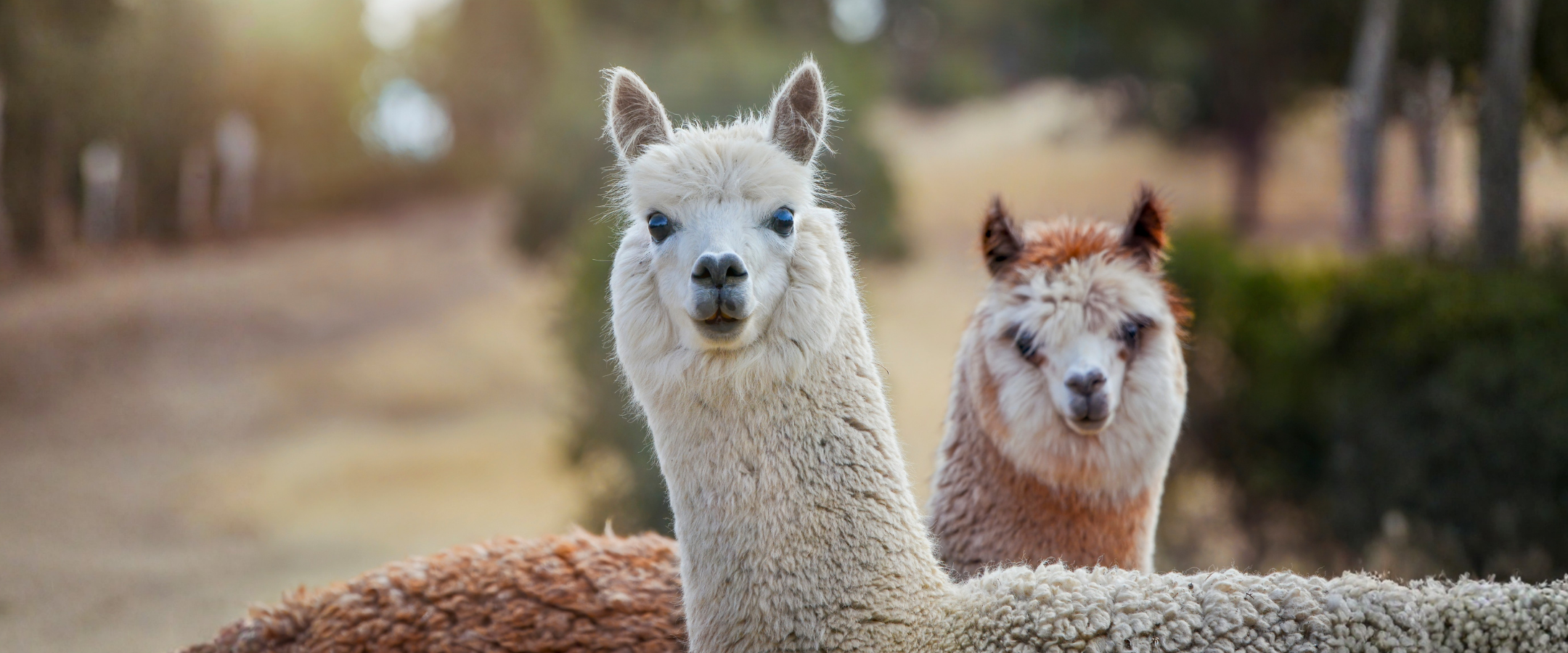
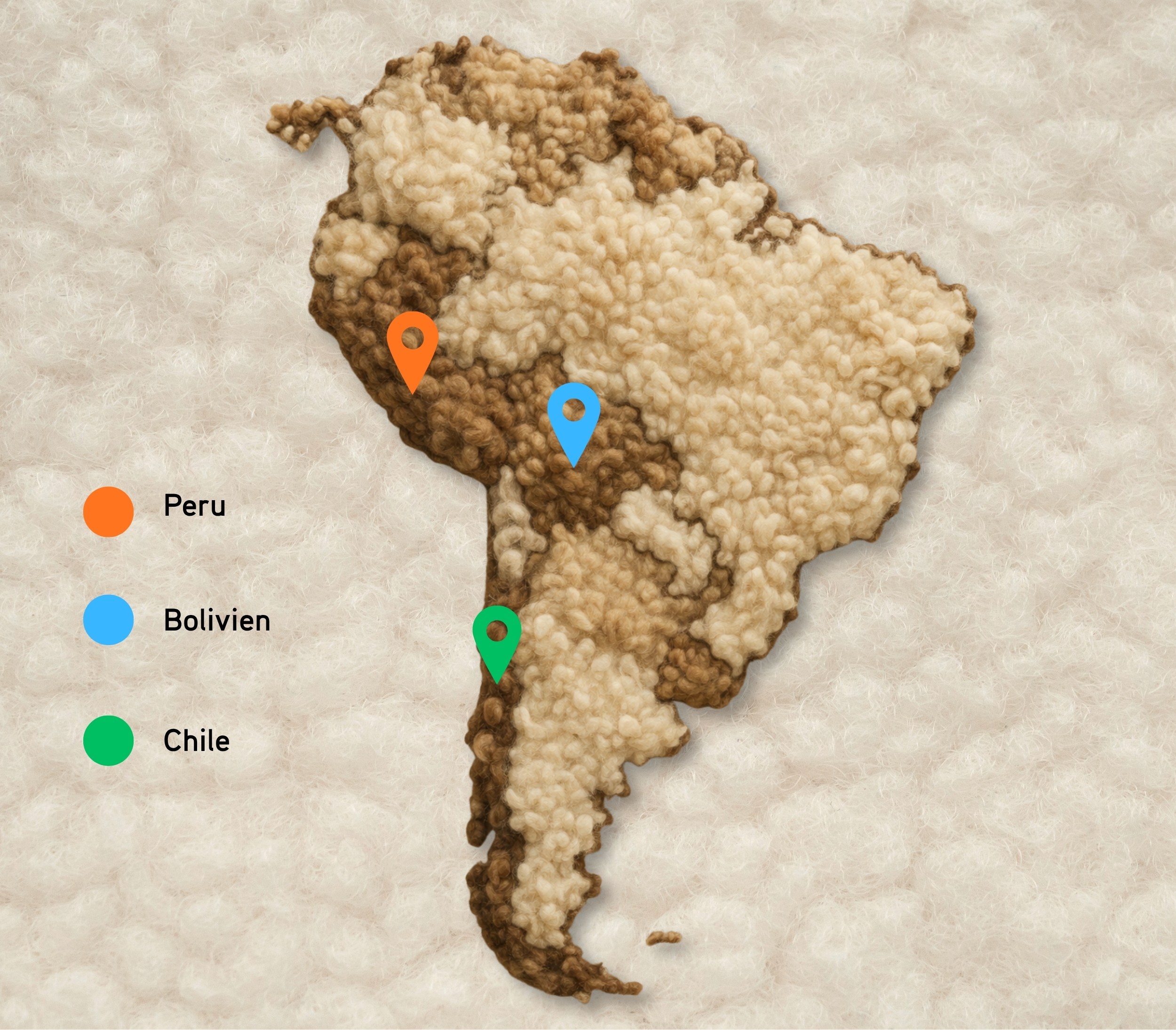
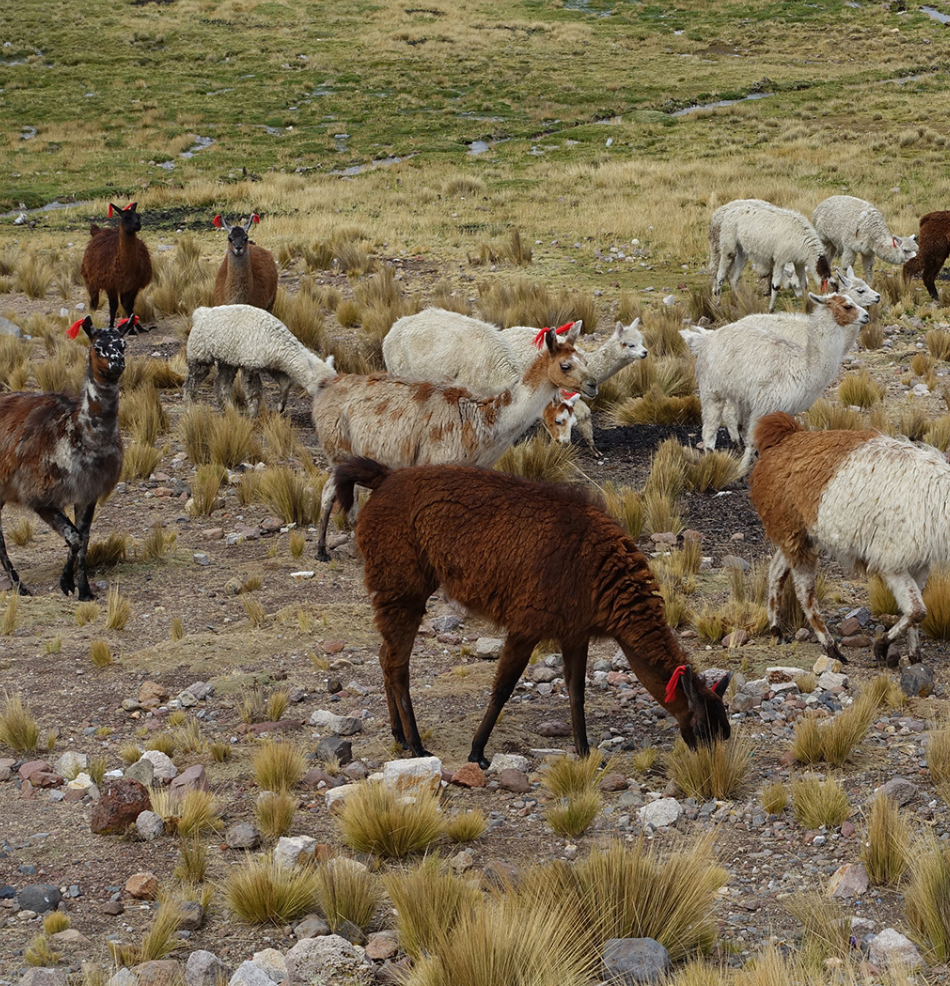
The alpaca (Vicugna pacos) belongs to the family of New World camelids and is native to the high-altitude regions of the South American Andes. New World camelids comprise four species found in South America—alpaca, llama, guanaco and vicuña—which belong to the camel family (Camelidae) but, unlike their relatives in Africa and Asia, do not have humps. Alpacas are particularly widespread in Peru, Bolivia and Chile, where they have been kept as livestock for thousands of years. They live at altitudes of up to 5,000 metres, in extreme climatic conditions that play a key role in shaping the unique characteristics of their fibre.
Archaeological evidence shows that alpacas were domesticated more than 5,000 years ago. For the pre-Columbian cultures of the Andes, particularly the Inca, alpaca fibre held great significance. Textiles made from it were considered valuable goods and were at times reserved for the nobility—an indication of their exceptional quality and status.
Today, Peru is the world’s leading producer of alpaca fibre. The animals are bred primarily for their fine, high-quality fleece, which is regarded as one of the most valuable natural fibres in the textile industry and is appreciated for its distinctive properties.
1.2 Appearance & Behaviour
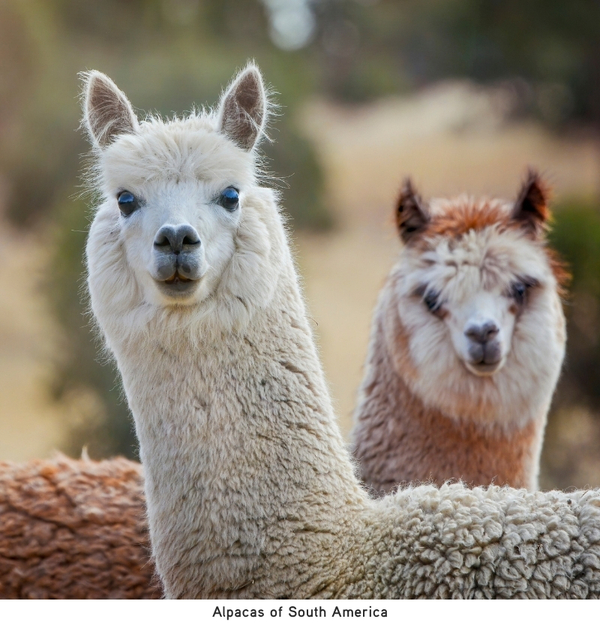
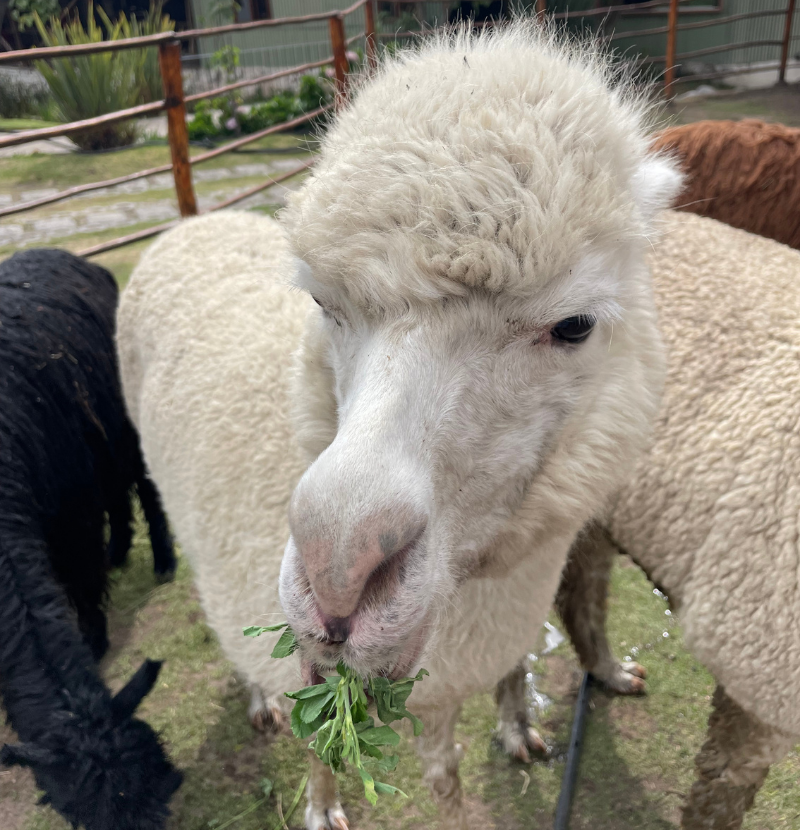
Alpacas are slender camelids, around one metre in height, with long necks, large expressive eyes and a dense, soft fleece. Their wool occurs in more than 20 natural shades—from pure white and warm browns and greys to deep black. This natural range of colours makes alpaca wool particularly versatile in further processing.
In general, two types of alpaca are distinguished, which differ primarily in the structure of their fibre:
-
Huacaya alpaca
The most widespread type. The fibre is finely crimped, forming a dense, voluminous fleece with good elasticity. This structure makes it particularly suitable for warm, soft and textured textiles. -
Suri alpaca
Much rarer. The fibres grow in long, smooth locks that fall in silky strands and exhibit a natural sheen. Suri fibres are especially smooth and are often used for refined, flowing fabrics with a sleek appearance.
Alpacas are calm, social herd animals with a strong sense of group behaviour. They are exceptionally well adapted to the conditions of the Andes and cope well with significant temperature fluctuations and sparse vegetation. Their soft, padded feet are gentle on the sensitive soils of high-altitude pastures, supporting more sustainable grazing practices.
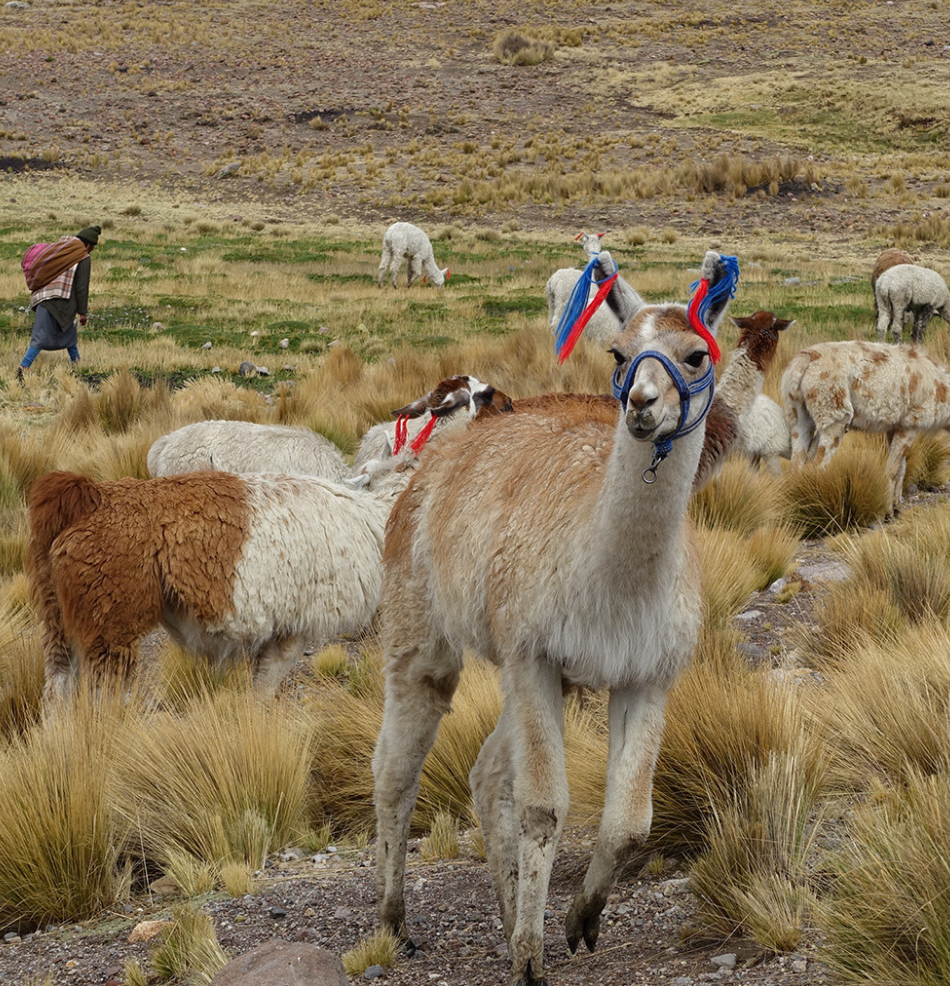
Our alpaca wool from South America
At Steiner1888, we source our alpaca wool from selected regions of South America, particularly Peru—the country of origin of alpaca breeding.
The extreme environmental conditions of the Andes—high altitudes, significant temperature variations between day and night, intense solar radiation and dry mountain air—give alpaca fibre its distinctive structure. As a result, it combines lightness with strong insulating properties.
Through careful selection and processing, we ensure that these natural characteristics are preserved in every product.
1.3 Breeding and harvesting of alpaca wool
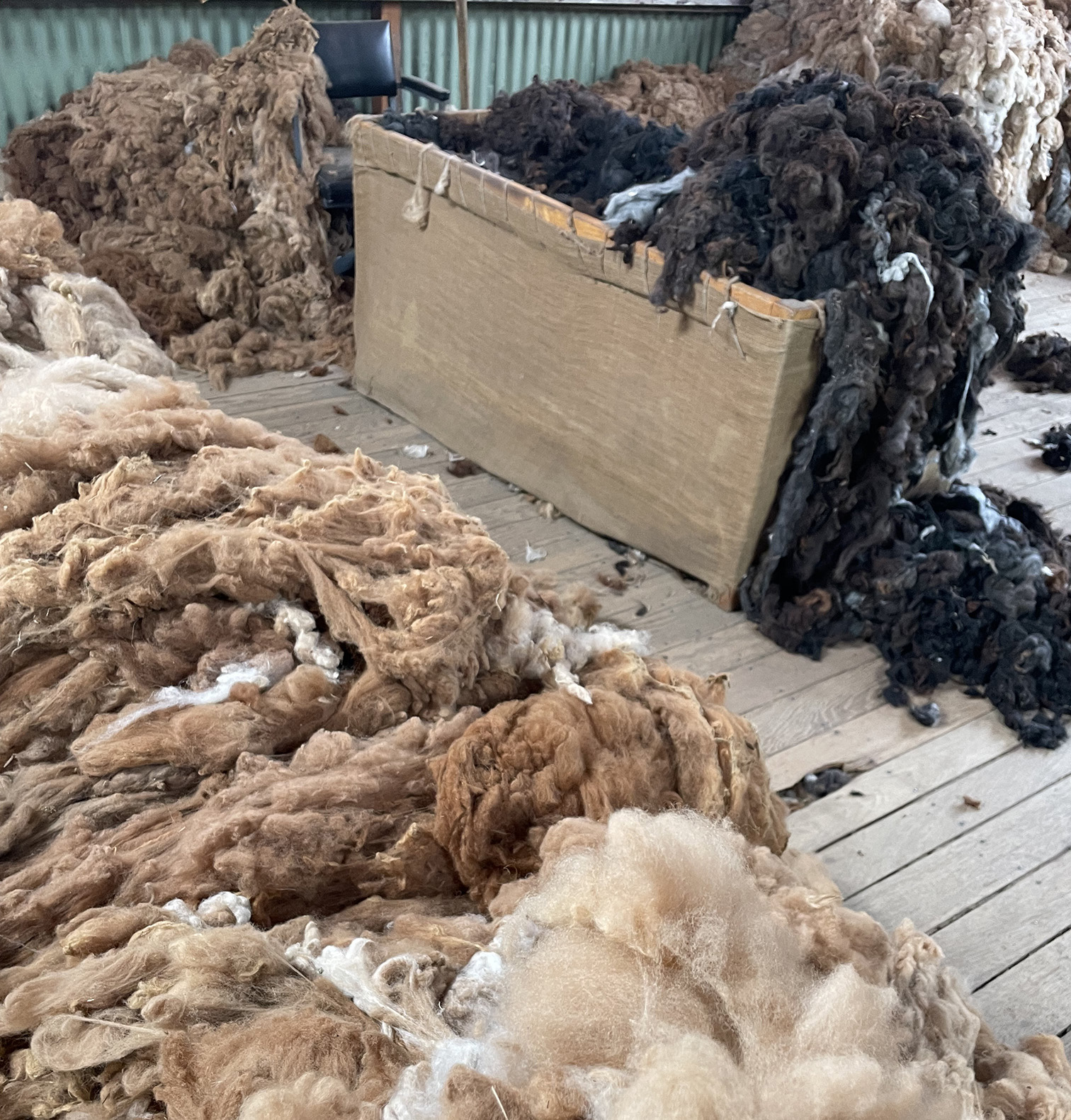
Alpacas are primarily kept for their high-quality fibre, which is regarded as one of the finest natural fibres in the textile industry. Shearing typically takes place once a year, usually in spring, and is also an important part of animal care.
On average, an alpaca yields between two and four kilograms of raw fibre per year. After shearing, the fleece is carefully sorted and evaluated according to several quality criteria:
- Fineness (measured in microns)
- Fibre length
- Purity
- Colour
The highest-quality fibre comes from the back and shoulder areas of the animal. Particularly fine grades are referred to as Baby Alpaca. This term generally describes fibres of exceptional fineness, often associated with the first shearing of young animals.
A characteristic feature of alpaca fibre is its low lanolin content. This makes it comparatively easy to clean and process. Depending on how the fibre is processed, spun and finished, a wide range of textile properties and applications can be achieved.
During sorting, the finest fibres from the back and shoulders are separated from coarser sections. Fibres from the belly, legs or neck are typically stronger and are used for other applications.
1.4 South American Camelids – Overview & Classification
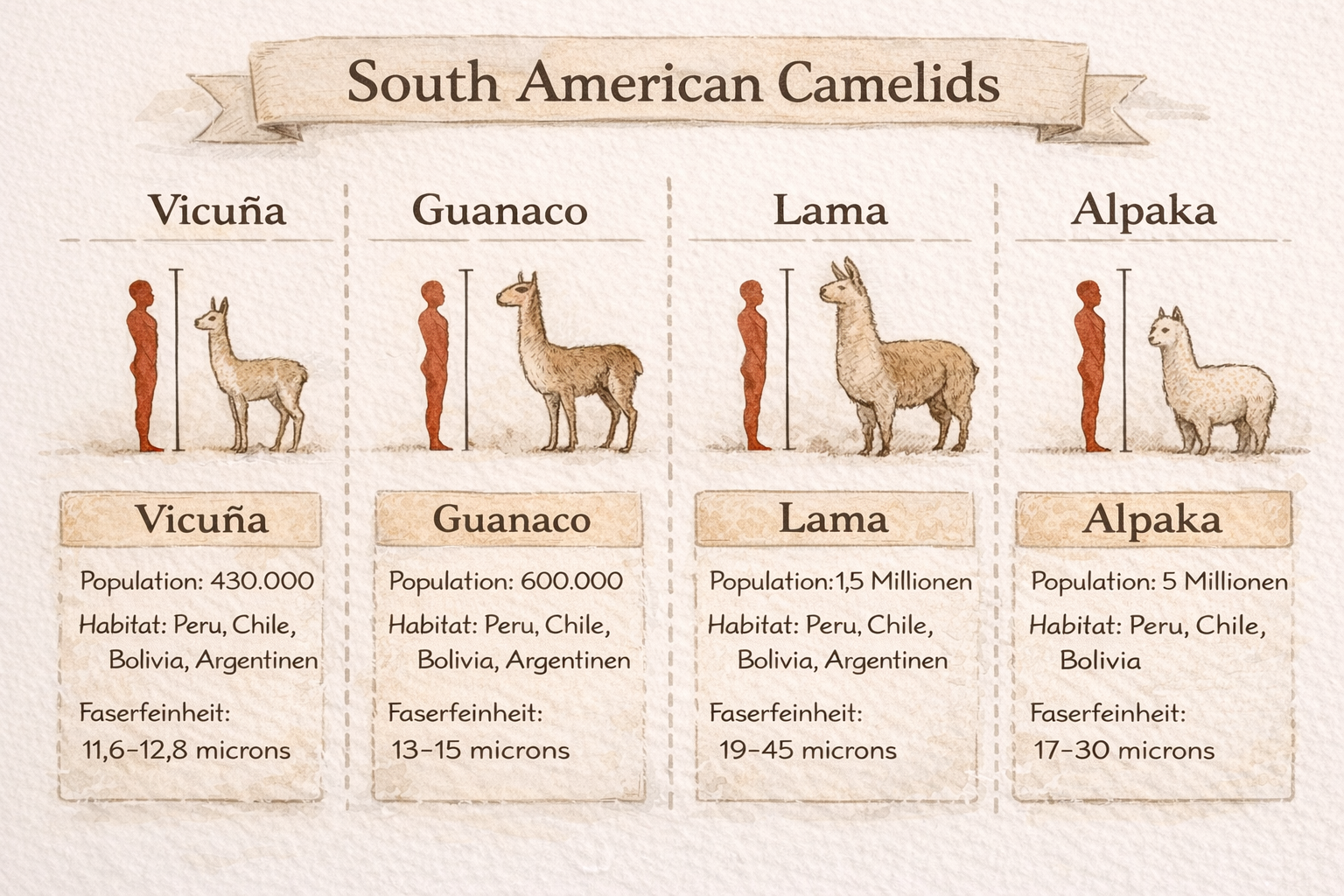
Alpaca wool is regarded as one of the finest natural fibres—its origin lies with the South American camelids. This group comprises four closely related species that have lived in the high-altitude regions of the Andes for thousands of years and are highly adapted to extreme climatic conditions.
South American camelids are generally divided into two groups:
- Wild – vicuña and guanaco
- Domesticated – llama and alpaca
All four species originate from the Andes of South America and differ primarily in their use, fibre quality and economic importance.
- Vicuña – The vicuña is the smallest South American camelid and produces one of the finest natural fibres in the world. Even during the Inca Empire, its wool was considered highly valuable and reserved exclusively for the nobility. After a period of severe endangerment, the species is now considered stable again thanks to targeted conservation efforts. The majority of animals are found in Peru.
- Guanaco – The guanaco is a wild, highly adaptable animal found from sea level up to altitudes exceeding 4,600 metres. It lives in social groups and produces a robust, high-quality fibre, often with a slightly reddish tone. It is particularly widespread in Patagonia.
- Llama – The llama is the largest domesticated camelid and has been used as a pack animal since pre-Columbian times. It plays a central role in transport, agriculture and culture in the Andean regions. Its fibre is coarser than that of the alpaca but is processed for a wide range of applications.
- Alpaca – The alpaca is the most important animal for the production of fine natural fibres. With a population of around four million—primarily in Peru—it forms the basis of modern alpaca fibre processing. The animals typically live at altitudes between 3,000 and 4,500 metres and produce particularly fine, versatile wool.
The differences between these camelids lie mainly in their use and fibre characteristics: while the vicuña represents exclusive luxury fibres and the llama is primarily valued as a working animal, the alpaca is considered the key source of high-quality fibres for the textile industry.
In this way, the alpaca represents a link between traditional animal husbandry, natural raw material sourcing and modern textile production—and today stands as a symbol of quality, comfort and responsible origin.
2. What makes alpaca wool so distinctive?
Alpaca wool is regarded as one of the high-quality natural fibres in the textile world. It combines strong thermal performance, low weight and a fine fibre structure, making it a versatile material for premium textiles.
- Fine fibre structure – Alpaca wool is characterised by a fine and consistent fibre, which, depending on processing, can result in a soft and pleasant handle.
- Excellent insulation – The fibre structure retains warmth efficiently and provides effective insulation while remaining lightweight.
- Temperature-regulating – Alpaca wool helps regulate temperature and, depending on how it is processed, can be used for both insulating and breathable textiles.
- Lightweight and durable – Despite its low weight, the fibre is resilient and suitable for long-lasting textiles.
- Natural sheen – The smooth surface of the fibre gives alpaca wool its characteristic, subtle sheen and refined appearance.
These qualities make alpaca wool well suited to high-quality garments, blankets and accessories. However, the actual characteristics of a finished product always depend on the specific processing methods and intended use.
Alpacas originate from the high-altitude regions of the South American Andes, particularly Peru and Bolivia, where their husbandry remains an important economic foundation for many communities. The animals are well adapted to life in mountainous environments: their soft, padded feet are gentle on vegetation, and their relatively low feed requirements make them a resource-efficient livestock.
In this way, alpaca wool combines natural functionality with a refined appearance and responsible origin—qualities that make it a versatile natural fibre in the premium segment.
Alpaca wool: processing determines the properties
With alpaca wool, the characteristics of a finished product depend not only on the fibre itself, but to a large extent on how it is processed. Whether the fibre is spun as woollen or worsted yarn, whether it is blended or felted—these factors have a decisive influence on structure, handle and end use.
For this reason, it cannot be stated in general terms that alpaca wool is inherently soft or suitable for sensitive skin. Such qualities arise from the specific processing and finishing of the material.
At Steiner1888, alpaca wool is used deliberately to achieve particular visual and tactile effects. Slightly coarser qualities are also selected intentionally to emphasise texture, character and a more distinctive surface—especially in interior applications.
3. Properties & benefits of alpaca wool
| Property | Benefit |
| Fine fibre structure (approx. 19–26 µm) | Depending on processing, can result in a soft and pleasant handle |
| Hollow fibre structure | Retains warmth efficiently and provides effective insulation |
| Temperature-regulating | Provides warmth in cold conditions while remaining breathable at higher temperatures |
| Low lanolin content | Generally well tolerated and easy to process |
| Natural sheen | Gives textiles a refined appearance with a subtle lustre |
| Durable & long-lasting | Good strength and low tendency to pill contribute to long-lasting products |
| 100% natural & biodegradable | Renewable raw material without synthetic additives |
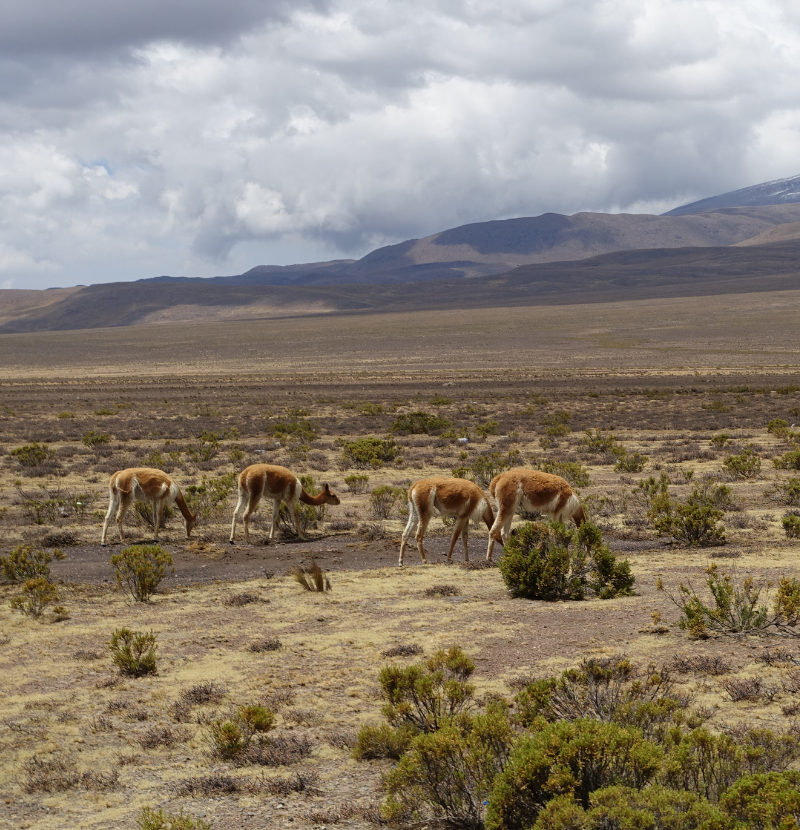
Fibre fineness and structure
The fineness of wool fibres is measured in microns and is a key factor influencing handle, elasticity and overall comfort.
Alpaca wool: approx. 19–26 microns
Merino wool: approx. 17–24 microns
Native mountain sheep: approx. 30–40 microns
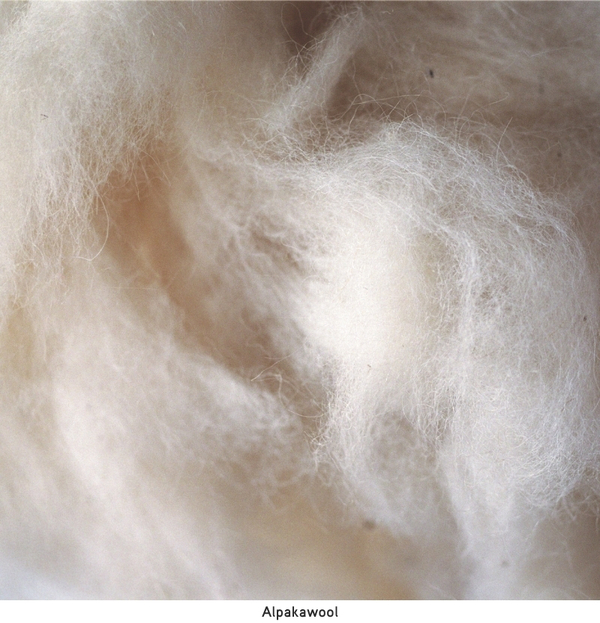
Alpaca fibres feature a particularly smooth surface and a characteristic hollow structure. This gives the material a lightweight feel while providing effective insulation. Depending on processing, the fine structure can result in a soft handle and contributes to the subtle, silky lustre typical of alpaca textiles.
4. Applications of alpaca wool
Thanks to its distinctive properties, alpaca wool is used across a wide range of applications within the textile industry. Its fine fibre structure, lightweight character and effective thermal performance make it a versatile natural material for high-quality textiles.
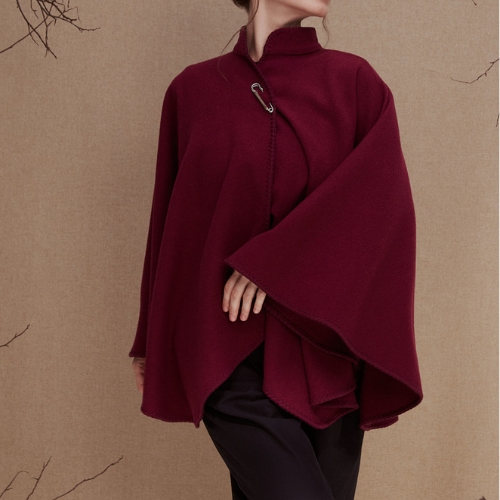
Clothing
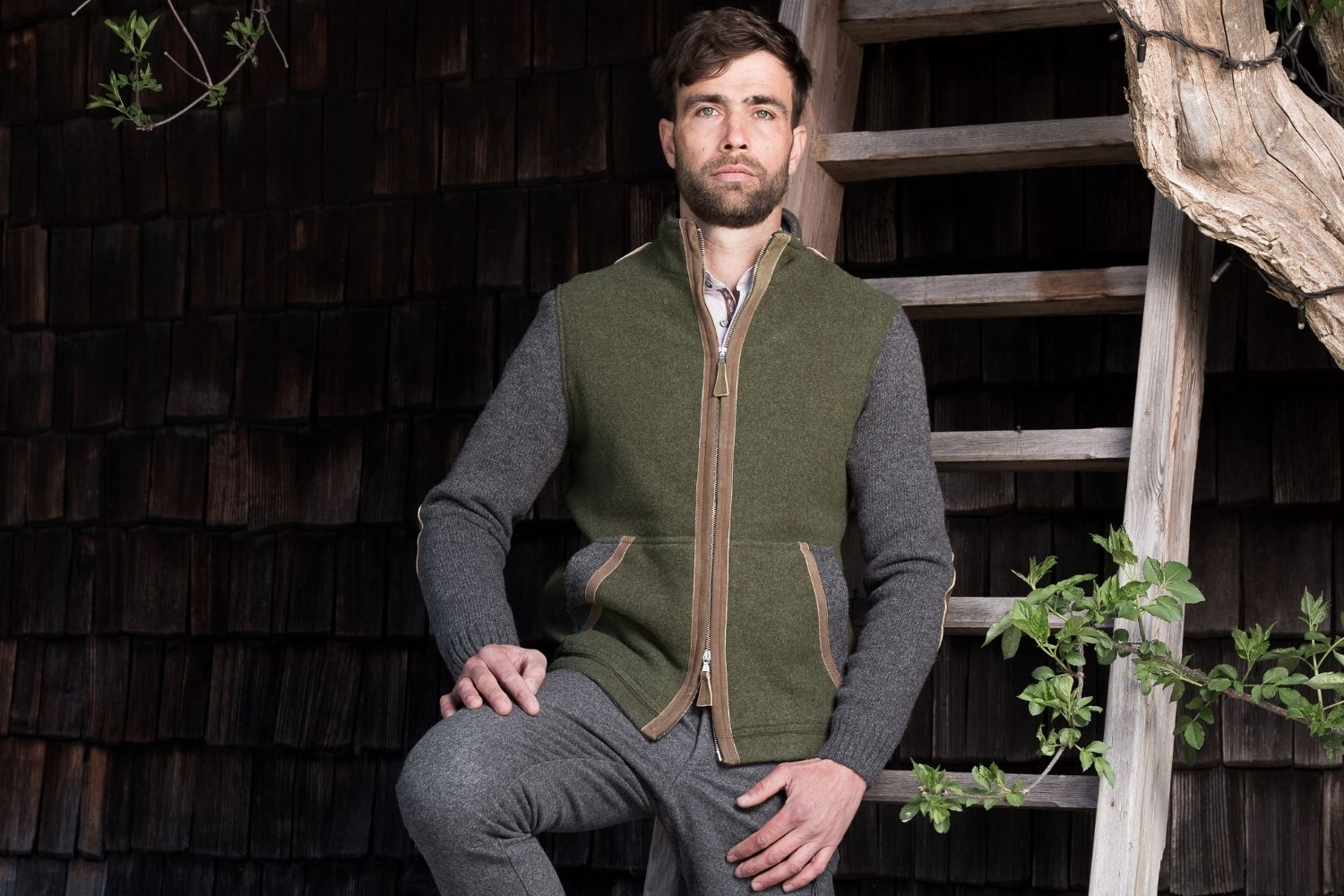
In apparel, alpaca wool is primarily used for high-quality, insulating textiles. The fibre stands out for its exceptional comfort, natural temperature regulation and inherent functionality.
Typical applications include:
- Coats and jackets
- Knitwear such as jumpers and cardigans
Alpaca wool is often blended with other natural fibres such as merino wool. This creates textiles that combine the softness and warmth of alpaca with the elasticity and shape retention of other fibres.
Accessories
Alpaca wool is also highly valued in the accessories segment for its softness and lightweight character. It offers exceptional comfort and a particularly pleasant handle.
Typical applications include:
- Scarves and hats
- Gloves
- High-quality fashion accessories
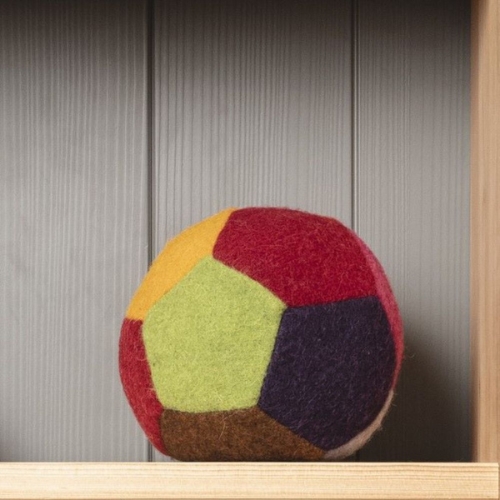
One example within the Steiner1888 collection is the Ball Daniel, which, with a 50% alpaca content, showcases the soft and premium qualities of this noble natural fibre particularly well.
Home textiles & interior
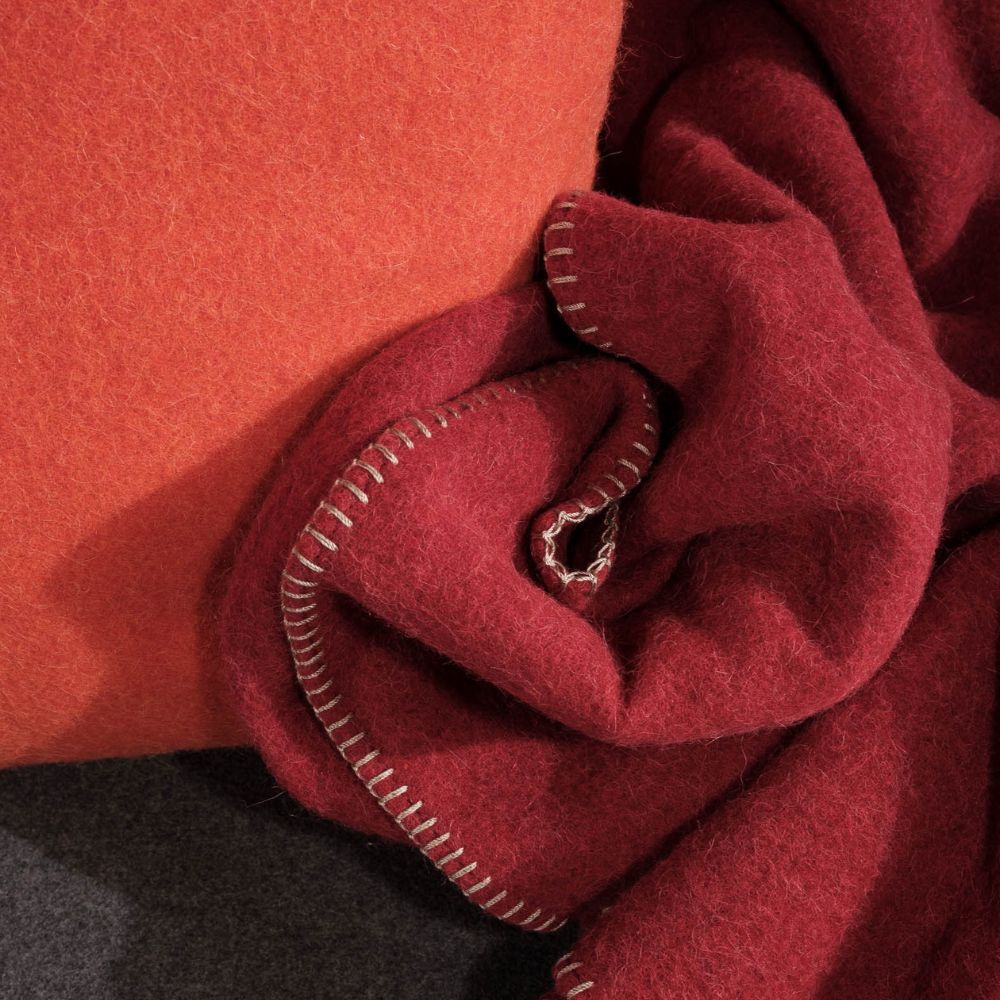
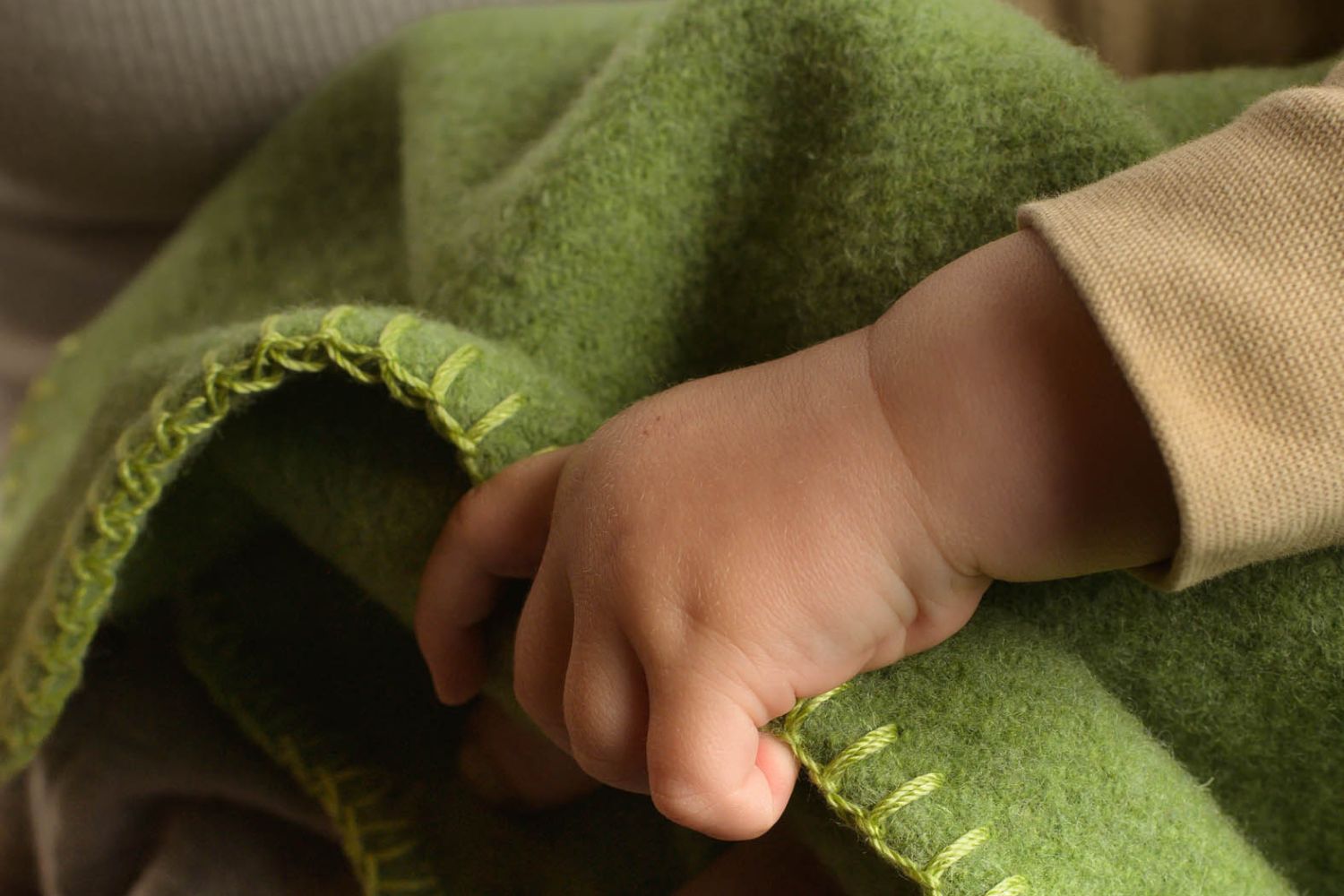
Alpaca wool is becoming increasingly important in interior settings. It provides natural warmth, exceptional comfort and an elegant aesthetic – making it ideal for high-quality, durable home textiles.
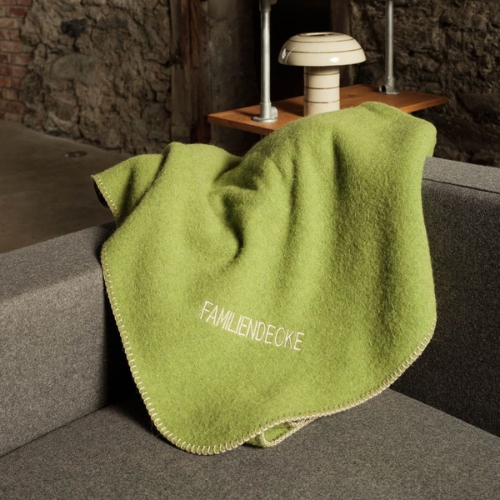
Typical applications include, in particular, throws and cushions, where the unique properties of alpaca wool can be fully appreciated.
One example is the Alina wool blanket, which, with a 50% alpaca content, combines the distinctive qualities of this noble natural fibre with comfort and lightness.
The combination of low weight, gentle warmth and natural lustre makes alpaca wool a sought-after fibre in the premium segment of high-quality home textiles.
Bei Steiner1888 steht Alpakawolle für natürliche Leichtigkeit, hochwertige Verarbeitung und einen bewussten Materialeinsatz. Die Faser aus den Anden wird gezielt ausgewählt und häufig mit anderen Naturfasern – insbesondere Merinowolle – kombiniert. So entstehen langlebige Textilien mit ausgewogenen Eigenschaften und einer charakteristischen Oberfläche.
Alpakawolle wird bei Steiner1888 vor allem im Interior-Bereich eingesetzt – insbesondere für Decken und Kissen. Durch die Kombination mit Merinowolle lassen sich Struktur, Griff und Funktion gezielt steuern. In Verbindung mit traditioneller Verarbeitung entstehen Produkte, die Natürlichkeit, Wohnlichkeit und handwerkliche Qualität vereinen.
5. Care of alpaca wool
Alpaca wool is considered particularly easy to care for and well suited to everyday use. Thanks to its unique fibre structure, it absorbs odours only minimally, meaning that regular airing is often sufficient to refresh the textiles.
Light soiling can usually be removed simply by shaking out or gently brushing the fabric. Washing is therefore only rarely required.
In the case of heavier soiling, gentle hand washing with lukewarm water (max. 30 °C) and a mild wool detergent is recommended. Alpaca fibres are sensitive to heat, friction and excessive wringing – textiles should therefore be handled with care and only gently pressed to remove excess water.
For drying, carefully reshape the product and lay it flat on a towel. Avoid direct sunlight and tumble drying to protect the delicate fibre structure.
Further helpful advice on cleaning and stain removal can be found on our care guide – helping to ensure the longevity and lasting quality of your alpaca wool products.
6. Structure of the Wool Fibre
The composition of a wool fibre depends on the breed and origin of the sheep, but one principle always applies: the main component of all animal fibres is protein, particularly keratin. This unique protein forms an extremely elastic and resilient fibre due to its spiral molecular structure. The degree of polymerisation (DP value) of wool is around 100, making it one of the most complex natural fibres. The fibre body itself is divided into several layers:
Scale Layer (Cuticle)
The cuticle forms the outer layer of the wool fibre and consists of overlapping scale cells. It protects the fibre and is responsible for characteristic properties such as felting ability and dirt resistance. Three layers can be distinguished:
- Epicuticle (outer membrane): water-repellent to liquid droplets but permeable to water vapour – ideal for moisture management.
- Exocuticle: hardened and scale-like; it protects the fibre from abrasion and gives wool its felting capability.
- Endocuticle: serves as structural support and separates the cuticle from the inner fibre.
Cortex (Spindle Cell Layer)
The cortex forms the main part of the fibre. It consists of millions of spindle-shaped cells, which are divided into two areas:
- Orthocortex: chemically less stable, more extensible and highly absorbent.
- Paracortex: more stable, less absorbent and less extensible.
Medulla (Core Layer)
The medulla is a central cellular layer that is particularly pronounced in coarser types of wool. It can reduce the softness of the fibre. Finer wool types, especially merino, contain only very small medullary islands or are almost medulla-free – which explains their exceptional softness.
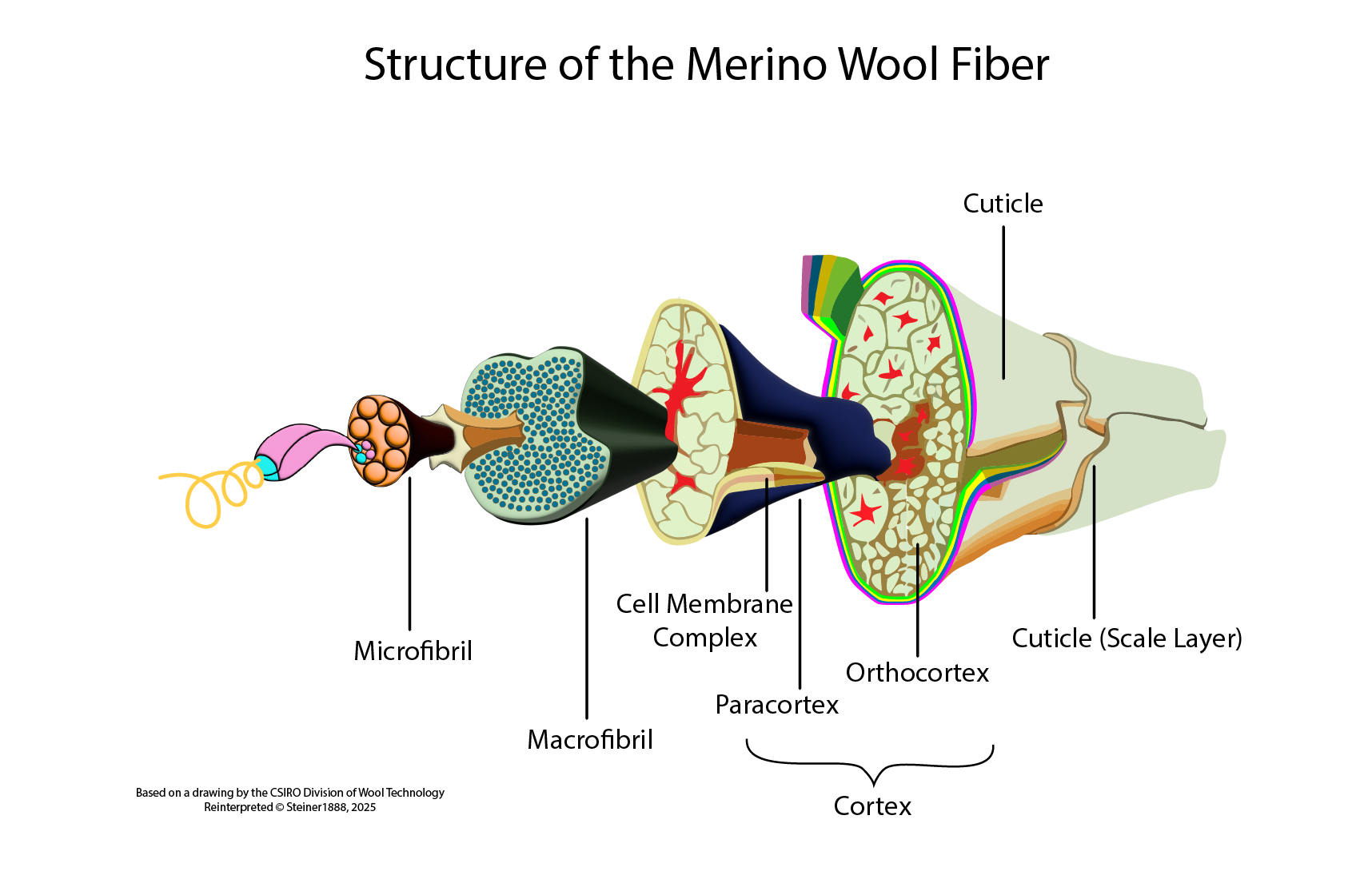
The interaction of these two layers creates the natural crimp of the wool fibre – a key characteristic responsible for its thermal insulation and elasticity. The cells are held together by a natural binding substance, lanolin (wool grease). It keeps the fibre supple and provides natural water- and dirt-repellent properties.
7. History, economic importance and current challenges
7.1 History of alpaca wool
The use of alpaca wool dates back over 5,000 years and is closely linked to the advanced civilisations of the Andes. Pre-Columbian cultures of South America – most notably the Inca – selectively bred alpacas for their fine, insulating fibre. Textiles made from alpaca wool were considered highly valuable within the Inca Empire and were, in some cases, reserved for nobility and the ruling elite. Beyond their practical function, they also held significant cultural and ceremonial importance.
With the Spanish colonisation in the 16th century, traditional alpaca farming initially declined in importance. European sheep breeds were introduced, reshaping existing agricultural systems. It was not until the 19th century that the European textile industry – particularly in Great Britain – rediscovered the potential of alpaca fibre, leading to the development of an international market for high-quality alpaca textiles.
Today, Peru is the world’s largest producer of alpaca wool, followed by Bolivia and Chile. Despite its relatively small share of global fibre production, alpaca wool is regarded as one of the finest natural fibres. Its combination of softness, thermal performance, lightweight character and natural lustre makes it a sought-after material for high-quality clothing, accessories and home textiles.
7.2 Economic importance and current challenges
For many communities in the Andean highlands, alpaca farming remains a vital economic foundation. It provides income for numerous families and is closely tied to traditional ways of life and grazing practices. Alpacas are perfectly adapted to the conditions of the Andes, requiring comparatively little water and feed, while their soft, padded feet help protect the delicate soils of high-altitude pastures.
At the same time, the sector faces a number of challenges. Fluctuating market prices, shifts in global textile trade and increasing competition from synthetic fibres all affect the economic stability of many producers. At the same time, global awareness of sustainable, natural materials and transparent supply chains continues to grow – an area in which premium natural fibres such as alpaca wool are gaining increasing relevance.
Thanks to its unique properties, alpaca wool remains one of the world’s most valuable natural fibres. Its natural origin, durability and functional benefits ensure that it will continue to play an important role in the premium segment – particularly in the field of high-quality interior and home textiles.